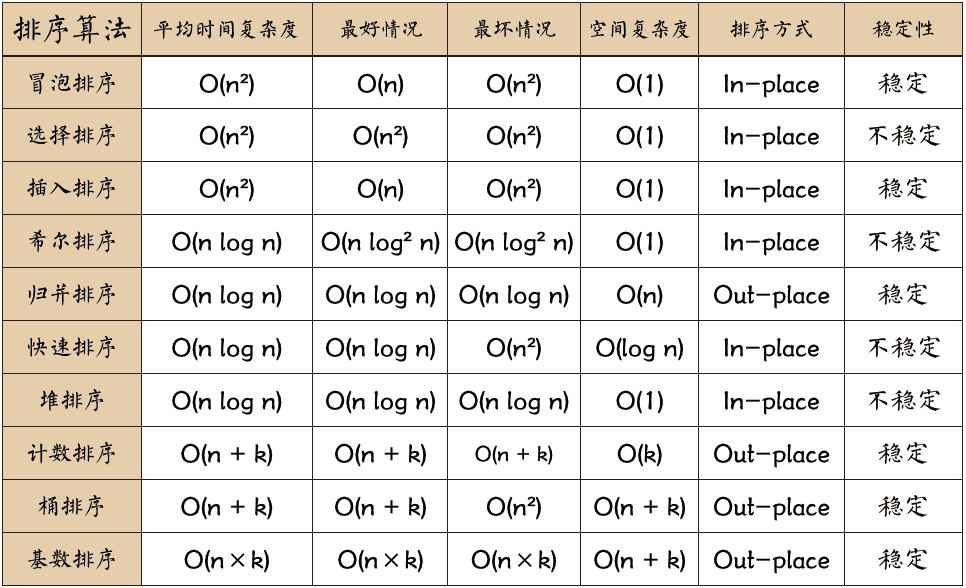
1. Selection SortThe algorithm divides the input list into two parts: a sorted sublist built up from left to right, and the remaining unsorted items. During each iteration, the smallest element from the unsorted section is identified and swapped into its correct position at the end of the sorted sub...
1. Sort Colors Given a array nums containing elements representing red, white, and blue colors (denoted by integers 0, 1, and 2 respectively), sort the array in-place so that objects of the same color are adjacent and arranged in the order red, white, and blue. The solution can be implemented using...
Bubble Sort **1. Core Concept:**Starting from the beginning of an unordered sequence, compare adjacent elements and swap them if needed to place larger (or smalller) values at the end of the sorted portion. This process continues until all elements are properly ordered. 2. Execution Flow****The bubb...
Given a array of elements representing colors using integers 0 (red), 1 (white), and 2 (blue), the task is to sort them in-place without using built-in sorting functions. The sorted array should group identical colors together in red-white-blue order. Two-Pass Pointer Approach This method processes...
The classic problem of arranging two sequences to maximize pairwise advantages can be modeled as an optimizaton task. Given two arrays of equal length, the goal is to permute the first array so that the count of positions where its element exceeds the corresponding element in the second array is max...
1D and 2D Integer Array Memory Layout Analysis #include <stdio.h> #define ROWS 2 #define COLS 4 void analyze_single_dim() { int values[COLS] = {1, 9, 8, 4}; int idx; printf("Total size of values: %lu bytes\n", sizeof(values)); for (idx = 0; idx < COLS; idx++) printf("Address...
Bubble Sort Two-pointer loop, swap when out of order, until the desired element floats to the boundary. function bubbleSort(arr) { const n = arr.length; for (let i = 0; i < n; i++) { for (let j = 0; j < n - i - 1; j++) { if (arr[j] > arr[j + 1]) { [arr[j], arr[j + 1]] = [arr[j + 1], arr[j]]...
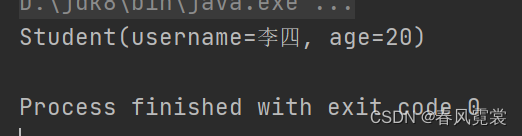
Sorting with the Comparable Interface Java provides the Comparable interface to define sorting rules for classes. Example: Define a Student class with age and username fields, implementing Comparable to provide comparison logic. Define a test class with a method getMax(Comparable c1, Comparable c2)....
Arrays Arrays are fundamental data structures used to store a fixed-size sequence of elements of the same type. Characteristics: Arrays are reference types, but their elements can be of any data type They allocate a contiguous block of memory in the system Elements are stored sequentially in memory...
This experiment demonstrates how to travrese a collection of student records using native iterator mechanisms in both Java and C++. The dataset consists of ten students, each with an ID, name, and age. The goal is to output the records sorted by ID in ascending and descending order, leveraging langu...