Basic Sorting Algorithms
Bubble Sort
Two-pointer loop, swap when out of order, until the desired element floats to the boundary.
function bubbleSort(arr) {
  const n = arr.length;
  for (let i = 0; i < n; i++) {
    for (let j = 0; j < n - i - 1; j++) {
      if (arr[j] > arr[j + 1]) {
        [arr[j], arr[j + 1]] = [arr[j + 1], arr[j]];
      }
    }
  }
}
Quick Sort
Key is how to implement partition. Common approach: choose the leftmost as pivot. First method: scan left to right, swap elements smaller than pivot to the left. Second method: two-pointer approach from both ends.
function swap(arr, i, j) {
  [arr[i], arr[j]] = [arr[j], arr[i]];
}

function partitionMethod1(arr, left, right) {
  let pivot = arr[left];
  let storeIndex = left + 1;
  for (let i = left + 1; i <= right; i++) {
    if (arr[i] < pivot) {
      swap(arr, i, storeIndex++);
    }
  }
  swap(arr, left, storeIndex - 1);
  return storeIndex - 1;
}

function partitionMethod2(arr, left, right) {
  let pivot = arr[left];
  while (left < right) {
    while (left < right && arr[right] > pivot) right--;
    arr[left] = arr[right];
    while (left < right && arr[left] <= pivot) left++;
    arr[right] = arr[left];
  }
  arr[left] = pivot;
  return left;
}

function quickSort(arr, left = 0, right = arr.length - 1) {
  if (left < right) {
    const pivotIndex = partitionMethod2(arr, left, right);
    quickSort(arr, left, pivotIndex - 1);
    quickSort(arr, pivotIndex + 1, right);
  }
}
Selection Sort
function selectionSort(arr) {
  for (let i = 0; i < arr.length; i++) {
    let minIndex = i;
    for (let j = i + 1; j < arr.length; j++) {
      if (arr[j] < arr[minIndex]) {
        minIndex = j;
      }
    }
    [arr[i], arr[minIndex]] = [arr[minIndex], arr[i]];
  }
}
Insertion Sort
function insertionSort(arr) {
  for (let i = 1; i < arr.length; i++) {
    let key = arr[i];
    let j = i - 1;
    while (j >= 0 && key < arr[j]) {
      arr[j + 1] = arr[j];
      j--;
    }
    arr[j + 1] = key;
  }
}
Shell Sort
function shellSort(arr) {
  let gap = 1;
  while (gap < arr.length / 3) {
    gap = gap * 3 + 1;
  }
  while (gap >= 1) {
    for (let i = gap; i < arr.length; i++) {
      let temp = arr[i];
      let j;
      for (j = i - gap; j >= 0 && arr[j] > temp; j -= gap) {
        arr[j + gap] = arr[j];
      }
      arr[j + gap] = temp;
    }
    gap = Math.trunc(gap / 3);
  }
}
Merge Sort
function merge(left, right) {
  let result = [];
  while (left.length && right.length) {
    if (left[0] < right[0]) {
      result.push(left.shift());
    } else {
      result.push(right.shift());
    }
  }
  return [...result, ...left, ...right];
}

function mergeSort(arr) {
  if (arr.length < 2) return arr;
  const mid = Math.trunc(arr.length / 2);
  const left = arr.slice(0, mid);
  const right = arr.slice(mid);
  return merge(mergeSort(left), mergeSort(right));
}
Heap Sort
// Complete binary tree: first non-leaf index = n/2 - 1, parent index = (n-1)/2, children indices = n2+1, n2+2
function heapify(arr, i, len) {
  let left = i * 2 + 1;
  let right = i * 2 + 2;
  let largest = i;
  if (left < len && arr[left] > arr[largest]) largest = left;
  if (right < len && arr[right] > arr[largest]) largest = right;
  if (largest !== i) {
    [arr[i], arr[largest]] = [arr[largest], arr[i]];
    heapify(arr, largest, len);
  }
}

function heapSort(arr) {
  const len = arr.length;
  // Build max heap
  for (let i = Math.trunc((len - 1) / 2); i >= 0; i--) {
    heapify(arr, i, len);
  }
  // Extract elements
  for (let i = len - 1; i > 0; i--) {
    [arr[0], arr[i]] = [arr[i], arr[0]];
    heapify(arr, 0, i);
  }
  return arr;
}
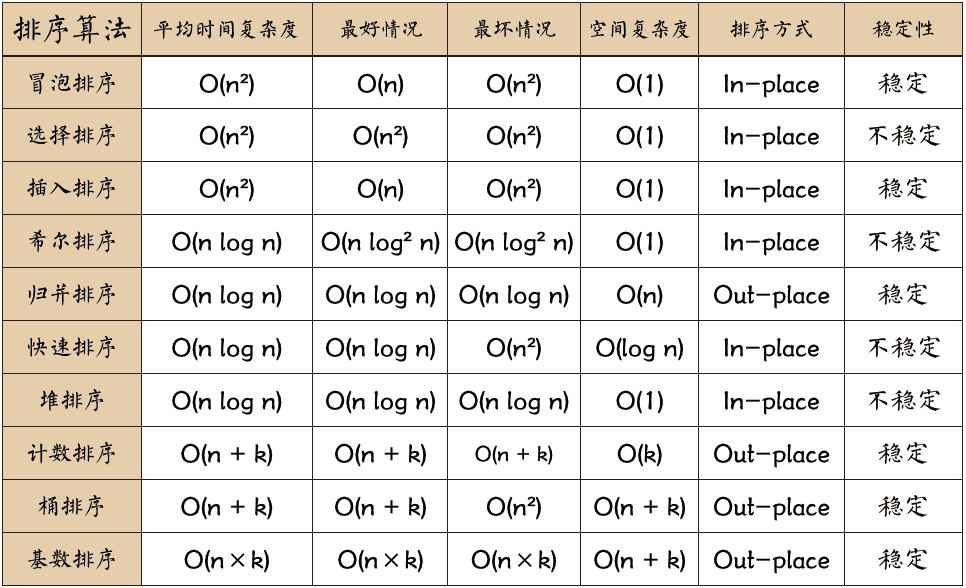
Comlpexity
References
- Sorting algorithms and their time complexities
- Top ten classic sorting algorithms
