Java Sorting Algorithms: Comparable Interface and Common Sorts
Sorting with the Comparable Interface
Java provides the Comparable interface to define sorting rules for classes.
Example:
- Define a
Studentclass withageandusernamefields, implementingComparableto provide comparison logic. - Define a test class with a method
getMax(Comparable c1, Comparable c2).
// Student.java
public class Student implements Comparable<Student> {
    private String username;
    private int age;

    public Student() {}

    public Student(String username, int age) {
        this.username = username;
        this.age = age;
    }

    public String getUsername() { return username; }
    public void setUsername(String username) { this.username = username; }
    public int getAge() { return age; }
    public void setAge(int age) { this.age = age; }

    @Override
    public int compareTo(Student other) {
        return this.age - other.age;
    }

    @Override
    public String toString() {
        return "Student{username='" + username + "', age=" + age + "}";
    }
}
// TestComparable.java
public class TestComparable {
    public static void main(String[] args) {
        Student s1 = new Student("Alice", 18);
        Student s2 = new Student("Bob", 20);
        Comparable max = getMax(s1, s2);
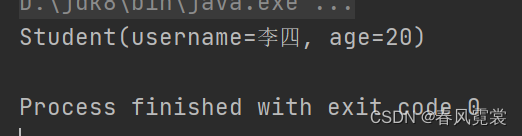
        System.out.println(max);
    }

    public static Comparable getMax(Comparable c1, Comparable c2) {
        int result = c1.compareTo(c2);
        if (result >= 0) {
            return c1;
        } else {
            return c2;
        }
    }
}
Simple Sorting Algorithms
(1) Bubble Sort
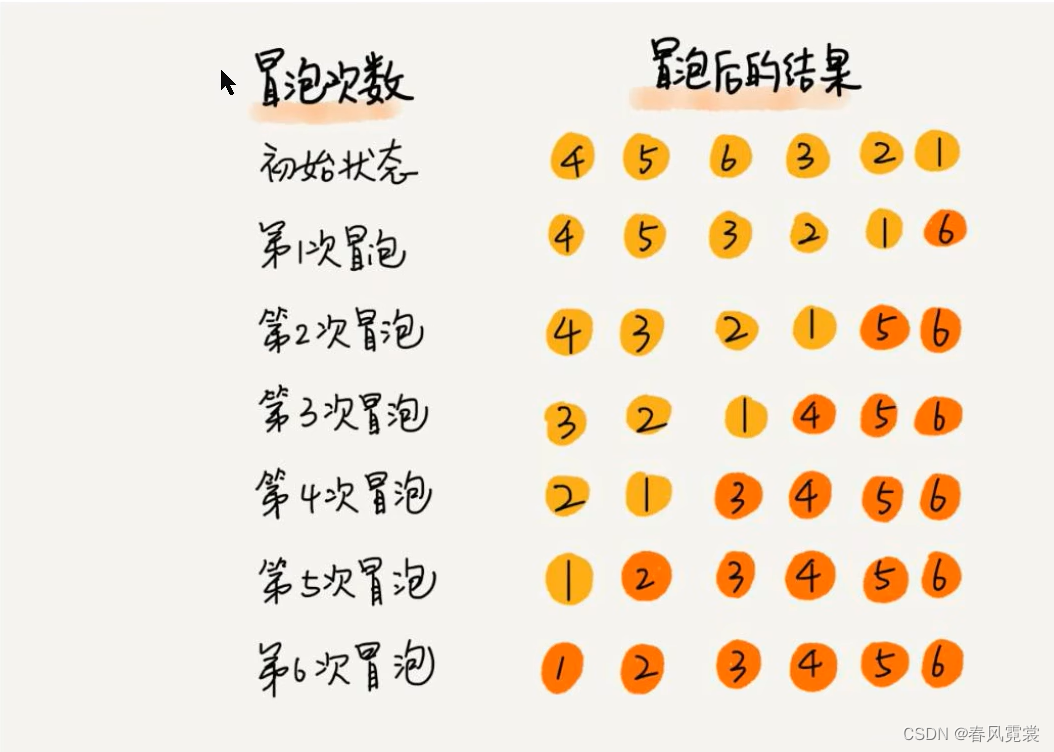
Requirement: Sort array {4,5,6,3,2,1} to {1,2,3,4,5,6}.
Principle:
- Compare adjacent elements. If the first is larger than the second, swap them.
- After each pass, the largest element moves to the end.
- Repeat for the remaining elements.
public class BubbleSort {
    public static void sort(Comparable[] arr) {
        int n = arr.length;
        for (int i = n - 1; i > 0; i--) {
            for (int j = 0; j < i; j++) {
                if (greater(arr[j], arr[j + 1])) {
                    swap(arr, j, j + 1);
                }
            }
        }
    }

    private static boolean greater(Comparable v, Comparable w) {
        return v.compareTo(w) > 0;
    }

    private static void swap(Comparable[] arr, int i, int j) {
        Comparable temp = arr[i];
        arr[i] = arr[j];
        arr[j] = temp;
    }
}
public class BubbleSortTest {
    public static void main(String[] args) {
        Integer[] arr = {4, 5, 6, 3, 2, 1};
        BubbleSort.sort(arr);
        System.out.println(Arrays.toString(arr));
    }
}
Time Complexity: O(N²) in worst case (e.g., reverse order).
(2) Selection Sort
Principle:
- In each pass, find the smallest element in the unsorted portion and swap it with the first element of that portion.
- The sorted portion grows from left to right.
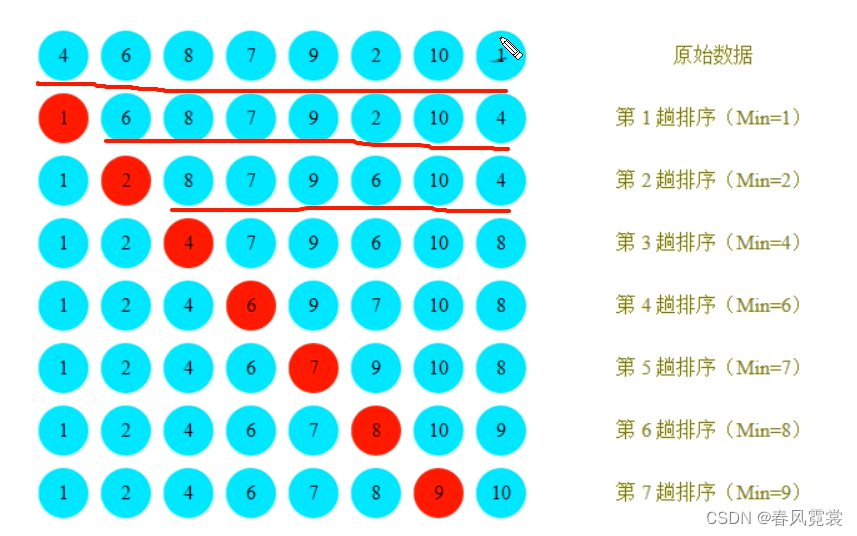
Requirement: Sort {4,6,8,7,9,2,10,1} to {1,2,4,6,7,8,9,10}.
public class SelectionSort {
    public static void sort(Comparable[] arr) {
        int n = arr.length;
        for (int i = 0; i < n - 1; i++) {
            int minIdx = i;
            for (int j = i + 1; j < n; j++) {
                if (greater(arr[minIdx], arr[j])) {
                    minIdx = j;
                }
            }
            swap(arr, i, minIdx);
        }
    }

    private static boolean greater(Comparable v, Comparable w) {
        return v.compareTo(w) > 0;
    }

    private static void swap(Comparable[] arr, int i, int j) {
        Comparable temp = arr[i];
        arr[i] = arr[j];
        arr[j] = temp;
    }
}
Time Complexity: O(N²) in all cases.
(3) Insertion Sort
Principle:
- Divide the array into sorted and unsorted parts.
- Take the first element from unsorted part and insert it into the correct position in the sorted part by shifting elements.
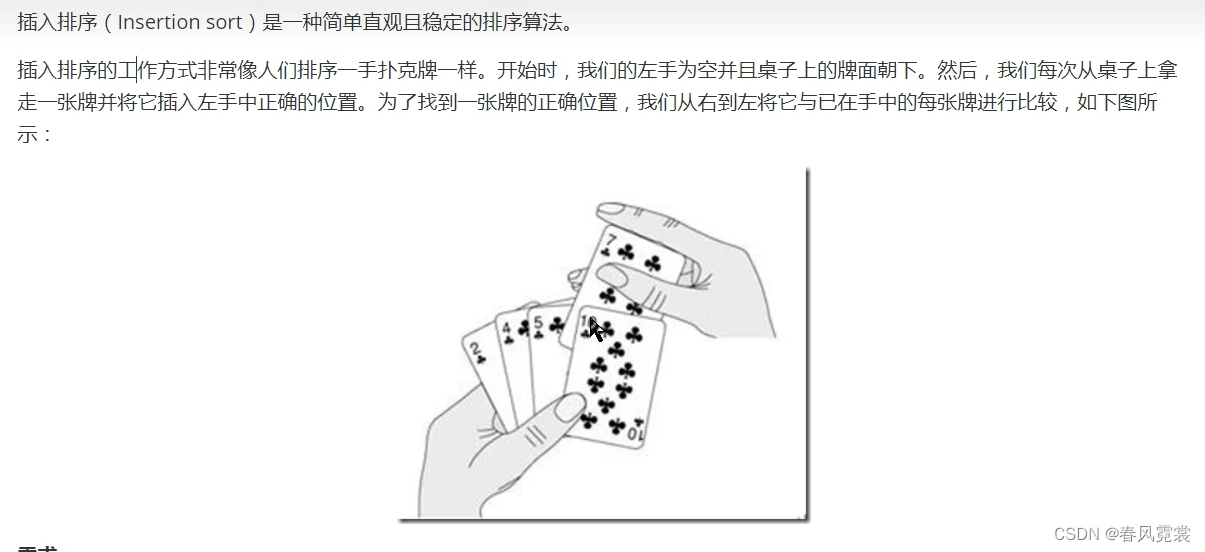
Requirement: Sort {4,3,2,10,12,1,5,6} to {1,2,3,4,5,6,10,12}.
public class InsertionSort {
    public static void sort(Comparable[] arr) {
        int n = arr.length;
        for (int i = 1; i < n; i++) {
            for (int j = i; j > 0; j--) {
                if (greater(arr[j - 1], arr[j])) {
                    swap(arr, j - 1, j);
                } else {
                    break;
                }
            }
        }
    }

    private static boolean greater(Comparable v, Comparable w) {
        return v.compareTo(w) > 0;
    }

    private static void swap(Comparable[] arr, int i, int j) {
        Comparable temp = arr[i];
        arr[i] = arr[j];
        arr[j] = temp;
    }
}
Time Complexity: O(N²) worst case, O(N) best case (nearly sorted).
Advanced Sorting Algorithms
(1) Shell Sort
Shell sort is an improved version of insertion sort that works by comparing elements separated by a gap (h). The gap decreases over time until it becomes 1.
Principle:
- Choose a gap sequence (e.g., h = 1, 4, 13, 40...).
- Sort subarrays of elements spaced by h using insertion sort.
- Reduce h and repeat until h = 1.
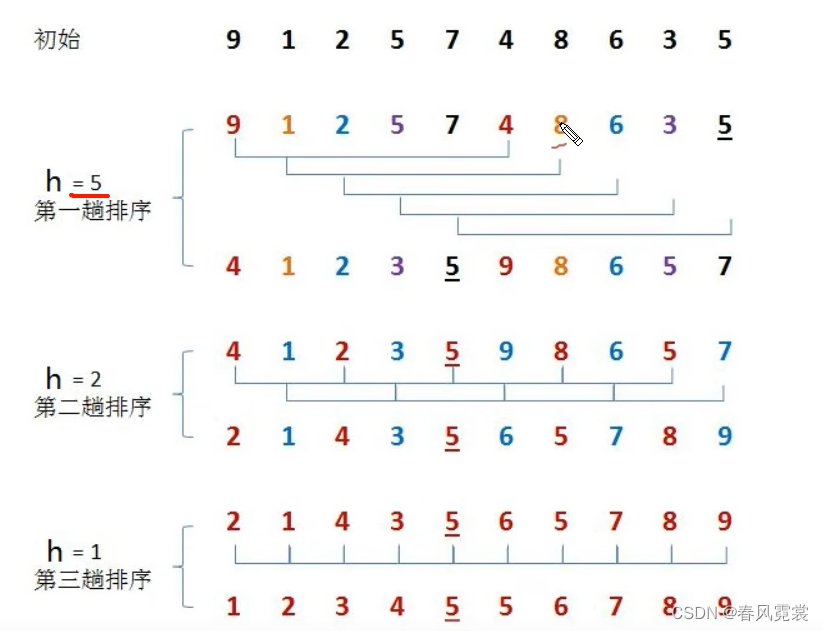
Requirement: Sort {9,1,2,5,7,4,8,6,3,5} to {1,2,3,4,5,5,6,7,8,9}.
public class ShellSort {
    public static void sort(Comparable[] arr) {
        int n = arr.length;
        int h = 1;
        while (h < n / 2) {
            h = 2 * h + 1;
        }
        while (h >= 1) {
            for (int i = h; i < n; i++) {
                for (int j = i; j >= h; j -= h) {
                    if (greater(arr[j - h], arr[j])) {
                        swap(arr, j - h, j);
                    } else {
                        break;
                    }
                }
            }
            h /= 2;
        }
    }

    private static boolean greater(Comparable v, Comparable w) {
        return v.compareTo(w) > 0;
    }

    private static void swap(Comparable[] arr, int i, int j) {
        Comparable temp = arr[i];
        arr[i] = arr[j];
        arr[j] = temp;
    }
}
Performance: Shell sort is much faster than insertion sort for large datasets. In tests with 100,000 random data points:
- Insertion sort: ~18057 ms
- Shell sort: ~18 ms
(2) Merge Sort
Merge sort uses divide-and-conquer: split the array into halves, sort each half recursively, then merge the sorted halves.
Principle:
- Split until each subarray has one element.
- Merge adjacent subarrays in sorted order.
- Repeat until one array remains.
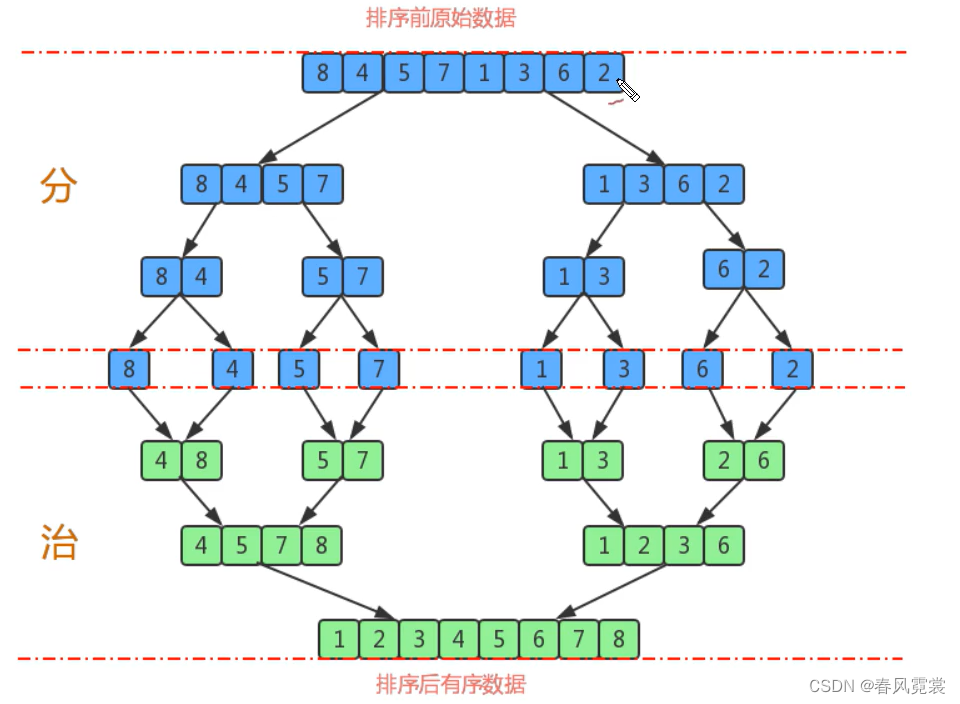
Requirement: Sort {8,4,5,7,1,3,6,2} to {1,2,3,4,5,6,7,8}.
public class MergeSort {
    private static Comparable[] aux;

    public static void sort(Comparable[] arr) {
        aux = new Comparable[arr.length];
        sort(arr, 0, arr.length - 1);
    }

    private static void sort(Comparable[] arr, int lo, int hi) {
        if (hi <= lo) return;
        int mid = lo + (hi - lo) / 2;
        sort(arr, lo, mid);
        sort(arr, mid + 1, hi);
        merge(arr, lo, mid, hi);
    }

    private static void merge(Comparable[] arr, int lo, int mid, int hi) {
        int i = lo, p1 = lo, p2 = mid + 1;
        while (p1 <= mid && p2 <= hi) {
            if (less(arr[p1], arr[p2])) {
                aux[i++] = arr[p1++];
            } else {
                aux[i++] = arr[p2++];
            }
        }
        while (p1 <= mid) aux[i++] = arr[p1++];
        while (p2 <= hi) aux[i++] = arr[p2++];
        for (int j = lo; j <= hi; j++) {
            arr[j] = aux[j];
        }
    }

    private static boolean less(Comparable v, Comparable w) {
        return v.compareTo(w) < 0;
    }
}
Time Complexity: O(N log N) in all cases. Disadvantages: Requires extra space O(N).
(3) Quick Sort
Quick sort also uses divide-and-conquer. It selects a pivot element and partitions the array sothat elements less than pivot go left, greater go right. Then recursively sort the partitions.
Principle:
- Pick a pivot (usually first element).
- Use two pointers: one from left looking for element greater than pivot, one from right looking for element less than pivot. Swap them until pointers cross.
- Swap pivot with right pointer to place it in correct position.
- Recursively sort left and right subarrays.
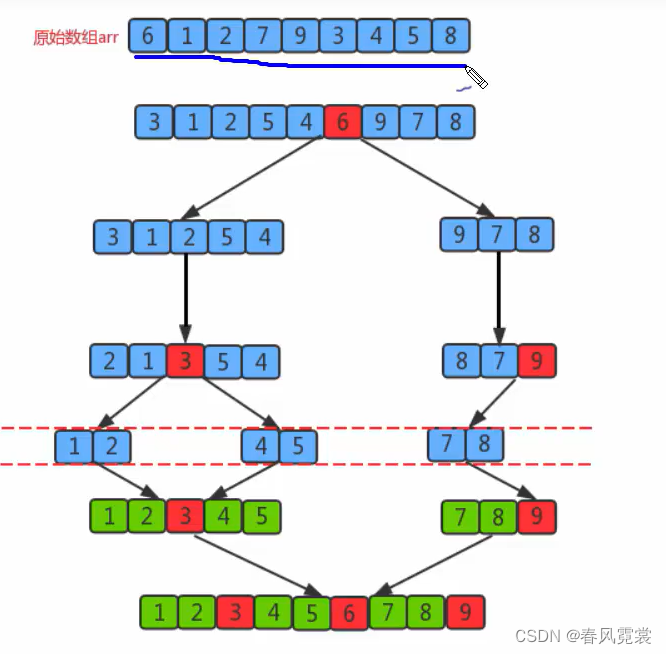
Requirement: Sort {6,1,2,7,9,3,4,5,8} to {1,2,3,4,5,6,7,8,9}.
public class QuickSort {
    public static void sort(Comparable[] arr) {
        sort(arr, 0, arr.length - 1);
    }

    private static void sort(Comparable[] arr, int lo, int hi) {
        if (hi <= lo) return;
        int pivotIdx = partition(arr, lo, hi);
        sort(arr, lo, pivotIdx - 1);
        sort(arr, pivotIdx + 1, hi);
    }

    private static int partition(Comparable[] arr, int lo, int hi) {
        Comparable pivot = arr[lo];
        int left = lo;
        int right = hi + 1;
        while (true) {
            while (less(pivot, arr[--right])) {
                if (right == lo) break;
            }
            while (less(arr[++left], pivot)) {
                if (left == hi) break;
            }
            if (left >= right) break;
            swap(arr, left, right);
        }
        swap(arr, lo, right);
        return right;
    }

    private static boolean less(Comparable v, Comparable w) {
        return v.compareTo(w) < 0;
    }

    private static void swap(Comparable[] arr, int i, int j) {
        Comparable temp = arr[i];
        arr[i] = arr[j];
        arr[j] = temp;
    }
}
Time Complexity: O(N log N) average, O(N²) worst case (when pivot is always smallest or largest).
Stability of Sorting Algorithms
Definition: A sorting algorithm is stable if equal elements maintain their relative order after sorting.
- Stable: Bubble, Insertion, Merge.
- Unstable: Selection, Shell, Quick.

Conclusion
This article covers common sorting algorithms in Java, their implementations, time complexities, and stability. Understanding these algorithms is fundamental for efficient data processing.
