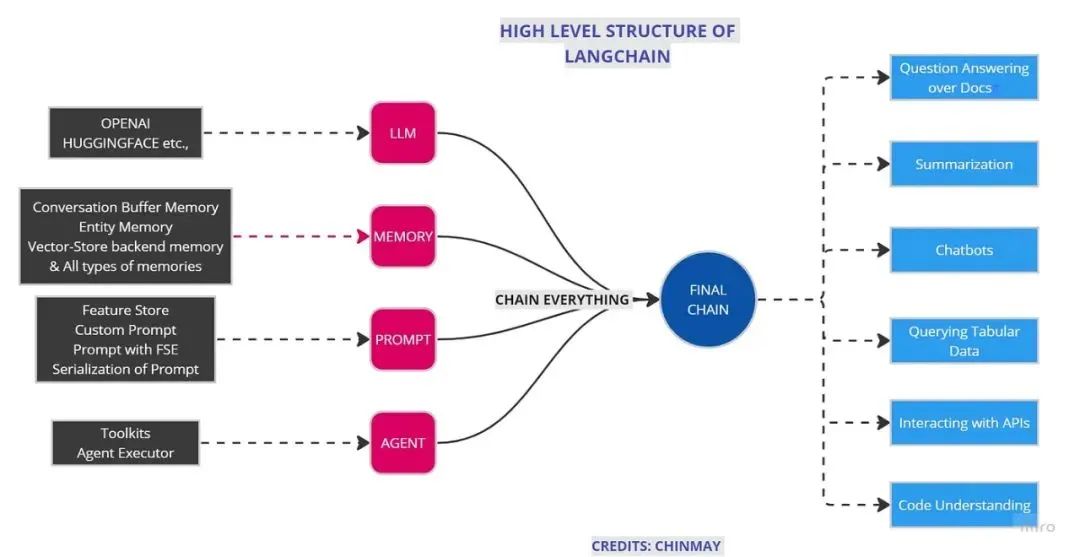
LangChain is an innovative framework that is revolutionizing how we develop applications powered by language models. By introducing advanced principles, LangChain is redefining the limits of what traditional APIs can achieve. Moreover, LangChain applications feature intelligent agents, enabling lang...
Agent Creation MethodologyAgents powered by Large Language Models (LLMs) are capable of autonomous thought and action. Development platforms typically offer three creation paths: no-code, low-code, and full-code. The no-code approach provides a streamlined creation process where the user inputs a ba...
Contextual Learning and IndexingModern generative Large Language Models (LLMs) demonstrate contextual learning capabilities, allowing them to perform new tasks without weight updates. By providing a few examples within the input prompt, the model can infer the desired pattern and generate appropriat...
Understanding Large Language Models Large Language Models (LLMs) have become a focal point in artificial intelligence since the emergence of ChatGPT. These models can process and generate human-like text, enabling capabilities such as text generation, question answering, conversation, and document s...
Natural Language Processing (NLP) enables computational systems to interpret and generate human language. Key tasks include text classification for spam filtering, sentiment analysis for social media monitoring, machine translation, automatic summarization, generative text creation, conversational a...
Due to recent performance throttling observed with certain AI coding assistants when used alongside domestic large language models, a shift toward fully self-hosted and controllable alternatives became necessary. Among the available options, opencode—an open-source AI coding agent—emerged as a promi...
Environment Configuration To begin working with LMDeploy, a compatible development environment must be established. This process involves setting up a Conda environment and installing the necessary dependencies. Creating the Conda Environment Initialize a new Conda environment named llm-inference wi...
Core Concepts of Prompt Patterns Prompt patterns serve as reusable templates that structure interactions with large language models (LLMs). They establish clear conventions for communication, enabling consistent and predictable model behavior. The catalog organizes these patterns into five functiona...
Ollama functions as a streamlined framework designed to facilitate the deployment of Large Language Models (LLMs) within containerized environments. By bundling model weights, configuration parameters, and data into a unified package known as a Modelfile, it abstracts away complex setup procedures i...
Core Prompt Components An effective prompt can be decomposed into four distinct elements: Directive: Defines the exact operation the model should execute. Payload: Supplies the specific content or data to be processed. Context: Provides environmental constraints, rules, or background details. Schema...