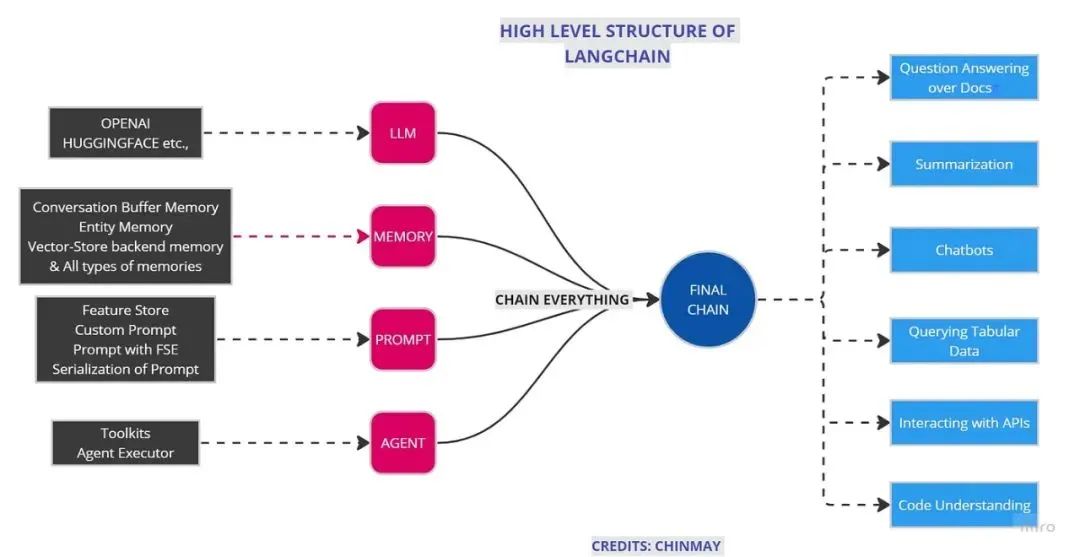
LangChain is an innovative framework that is revolutionizing how we develop applications powered by language models. By introducing advanced principles, LangChain is redefining the limits of what traditional APIs can achieve. Moreover, LangChain applications feature intelligent agents, enabling lang...
Environment Setup Install the necessary Python packages to interact with the OpenAI API and LangChain framework. pip install openai tiktoken langchain Configure your OpenAI API key as an environment variable for authentication. import os os.environ["OPENAI_API_KEY"] = "sk-your-api-key" Dataset Prepa...
Resolving HTTPS Timeout Errors When calling OpenAI endpoints, you may encounter HTTPSConnectionPool timeout exceptions. A reliable fix is to pin urllib3 to an earlier stable release: pip install urllib3==1.25.11 On Windows 11 with Python 3.9.18, running openai==1.12.0 alongside urllib3==1.25.11 typi...
Plan-and-Execute Agents Plan-and-Execute agents first plan what to do, then execute subtasks to accomplish the goal. This idea is primarily inspired by BabyAGI, followed by the "Plan-and-Solve" paper. Planning is almost always performed by an LLM (Large Language Model). Execution is typica...
Large language models inherently lack memory, as they process each input independently without retaining context from previous interactions. In practical applications, memory is simulated by appending the entire conversation history to each new prompt, allowing the model to generate contextually rel...
Understanding Retrieval-Augmented Generation (RAG) RAG is a methodology introduced to address knowledge-intensive NLP tasks. It merges two distinct forms of memory: parametric memory, encoded within pre-trained models like large language models (LLMs), and non-parametric memory, which consists of ex...
LangChain is a comprehensive framework designed to streamline the development of advanced language model-powered applications. It provides modular components, standardized interfaces, and integration tools that enable developers to build end-to-end systems leveraging large language models (LLMs) and...
This guide introduces core runnable operation utilities in LangChain that simplify building flexible, input-compatible LLM applicasion chains. RunnablePassthrough The RunnablePassthrough component is part of the langchain_core.runnables module. It is used too pass input values unmodified between cha...
When executing LangChain workflows that interface with OpenAI models, an error is raised if the OPENAI_API_KEY environment variable is not defined. In-Code Environment Variible Assignment A temporary key can be assigned within the script to bypass the initialization error. This is suitable for testi...