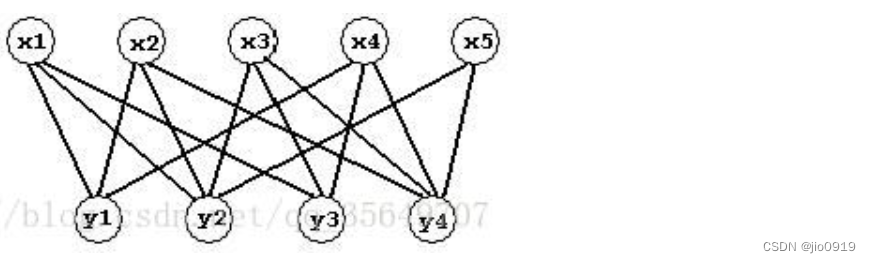
Original Model and Related Concepts of Bipartite Graphs A bipartite graph, also known as a bigraph, is a special model in graph theory. Let G = (V, E) be an undirected graph. If the vertex set V can be partitioned into two disjoint subsets (A and B), and every edge (i, j) in the graph connects verti...
Given four positive integers (x, y, z, H), the goal is to count the number of integers (d) in the range ([0, H]) that can be expressed as (d = a x + b y + c z), where (a, b, c) are non-negative integers. If a value (k) can be written as (k = b y + c z) with non-negative (b) and (c), then (k) is a va...
Graphs are non-linear data structures consisting of vertices (nodes) and edges that connect them. Formally denoted as $G = (V, E)$, where $V$ represents the set of vertices and $E$ represents the set of edges, graphs are widely utilized to model relationships in computer networks, logistics, and soc...
DFS Trees in Graph Theory A DFS tree is formed during a depth-first search traversal of a graph or tree structure. Starting from a root vertex, the algorithm explores as far as possible along each branch before backtracking. In this process, edges traversed to unvisited nodes become tree edges, whil...