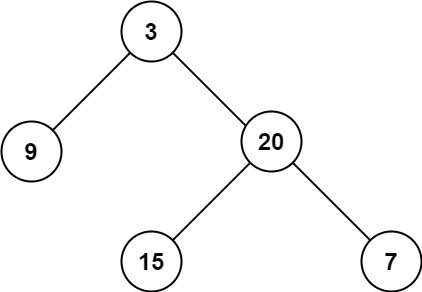
Depth-First Traversal (DFS) LeetCode 144: Preorder Traversal Recursive Approach: class Solution { public: void visitNodes(TreeNode* node, vector<int>& output) { if (!node) return; output.push_back(node->val); visitNodes(node->left, output); visitNodes(node->right, output); } vecto...
Recursive Traversal Implementations Perorder Traversal Process the node's value before visiting its left and right subtrees. void preorderTraverse(TreeNode* currentNode, vector<int>& results) { if (currentNode == nullptr) { return; } results.push_back(currentNode->value); preorderTraver...
Binary Tree Problem-Solving Approaches When solving binary tree problems, two primary thinking patterns are commonly used: Traversal-Based Approach: This approach focuses on whether the solution can be obtained by traversing the binary tree once. Typically, a traversal function (such as pre-order, i...
The problem requires constructing a binary tree given two integer arrays, preorder and inorder, representing the tree's preorder and inorder traversals, respectively, and returning the root node. The solution leverages the distinct properties of these traversal orders. In a preorder traversal, nodes...
Binary Tree Depth (Recursion/Level Traversal) Tree structures represent hierarchical data with recurisve properties. For practical use, a struct with left and right pointers (or indices) to track child nodes suffices. Problem: Binary Tree Depth This problem focuses on binary tree storage and depth c...
Binary Tree Terminology Root Node: A node with no parent. Leaf Node: A node with no children. Edge: The line segment connecting two nodes. Level: Incrementing from top to bottom, with the topmost level being 1. Degree of a Node: The number of child nodes it has. Height of a Binary Tree: The length (...
Every recursive tree traversal follows a consistent decomposition built from three parts: a function signature that accepts the current subtree and an output collector, a base case that stops descent, and the logic that treats each deeper call as already completed. Recursive Depth-First Traversal Th...
The concept of "maintaining" a data structure involves preserving its inherent properties during operations. For instance, maintaining a monotonic queue ensures specific elements are removed during push and pop operations to keep the queue's monotonic order. Core Concepts of Binary Trees T...
The Morris algorithm achieves constant auxiliary space complexity by temporarily converting the binary tree into a threaded structure, utilizing null child pointers to establish return paths instead of explicit stacks or recursion. Core Threading Mechanism The fundamental operation involves locating...
Given a binary tree: struct Node { int val; Node *left; Node *right; Node *next; } Populate each next pointer to point to its next right node. If there is no next right node, the next pointer should be set to NULL. Initially, all next pointers are set to NULL. Example 1: Input: root = [1,2,3,4,5,nul...