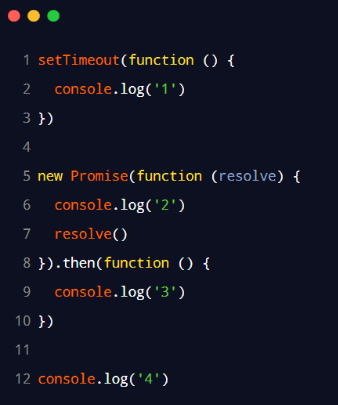
To implement a custom Promise, one must understand its fundamental behavior: it is a constructor that accepts a executor function (which receives resolve and reject callbacks). The state of a Promise transitions from pending to either fulfilled (resolved) or rejected, and the then method allows us t...
In single-threaded JavaScript, asynchronous execution is managed via callback functions. Consider how operating systems handle interrupts: while a peripheral device completes I/O, the CPU continues other work until an interrupt signals completion. Callbacks operate on a similar principle—the runtime...
1. Promise Methods Overview Promise.resolve Wraps a value into a resolved promise. Promise.resolve('hello').then(s => console.log(s)); Promise.reject Wraps a value into a rejected promise. Promise.reject(reason).catch(e => console.log(e)); Promise.all Waits for all promises to resolve. Rejects...
A Promise is a built-in JavaScript object introduced in ECMAScript 2015 that represents the eventual outcome of an asynchronous operation — either a resolved value or a reason for rejection. Each Promise instance transitions through exactly one of three mutually exclusive states: Pending: The initia...
Array Destructuring Traditional syntax for extracting array values involves verbose index referencing. let numberList = [1, 2, 3]; let x = numberList[0]; let y = numberList[1]; let z = numberList[2]; console.log(x, y, z); ES6 destructuring provides a concise alternative. let numberList = [1, 2, 3];...
Learning Objectives Understand how to use ES6 module syntax, including default and named exports/imports. Learn to use Promises to solve callback hell issues. Simplify Promise calls using async/await. Explain what the EventLoop is and how it processes asynchronous tasks. Describe the execution order...
Synchronous vs Asynchronous Execution Models In blocking (synchronous) execution, operations run sequentially. Each statement waits for the previous one to complete before executing. When encountering time-consuming I/O operations or network requests, the entire thread halts, creating performance bo...
Core Concepts of ES6 Promises A Promise represents the eventual completion (or failure) of an asynchronous operation and its resulting value. It addressse callback hell by providing a structured way to handle async flows. Basic Promise Execution Flow Consider an asynchronous task using setTimeout: /...
Example 1 Key Concept: A Promise can only change its state once const myPromise = new Promise((fulfill, reject) => { reject(); fulfill(); }); myPromise.then( () => console.log('Success'), () => console.log('Failure') ); Output: Failure Example 2 Key Concept: resolve() and reject() do not te...