Stack A stack is a linear data structure that follows the Last-In-First-Out (LIFO) principle. Only the most recently added element can be accessed or removed. Key Characteristics LIFO behavior: The last element pushed onto the stack is the first one popped off. Single access point: All operations oc...
A stack is a linear data structure adhering to the Last-In-First-Out (LIFO) principle. The top of the stack is where elements are added and removed, while the bottom remains fixed. Common Stack Operations Standard stack operations include push (add to top), pop (remove from top), and peek (inspect t...
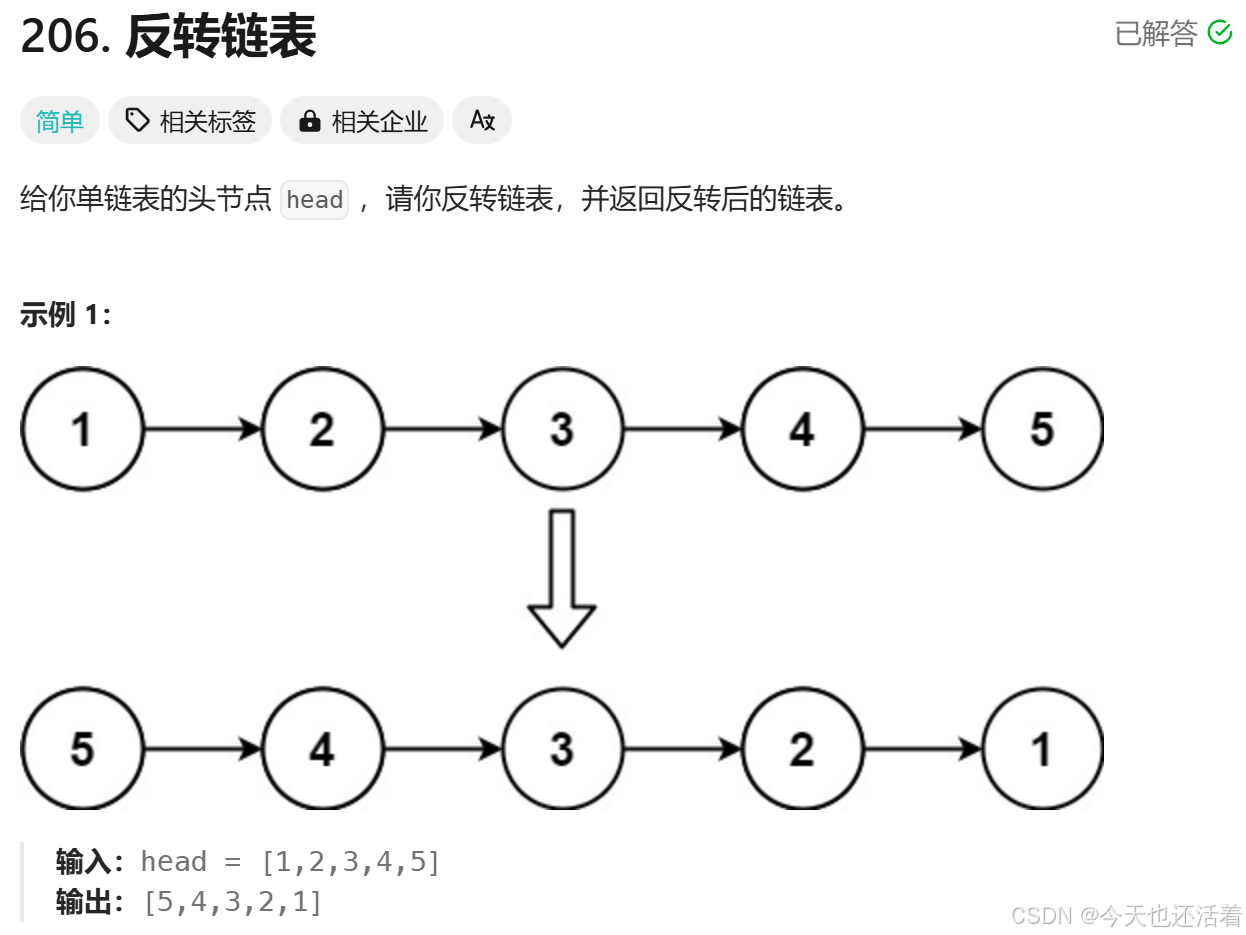
LeetCode Problem 206: Reverse Linked List Problem Description: Solution: Using a two-pointer approach with previous and current pointers, iteratively modify pointer directions. Pay atttention to the loop termination condition; return the previous pointer as the new head node. /** * Definition for si...
Consider we have n points indexed from 1 to n, each storing a numeric value. We often need to perform updates or aggregate queries over the continuous subrange [L, R]. The segment tree enables both update and query operations in O(log n) time complexity. The core idea of a segment tree is to recursi...
Lists A list is an ordered collection of elements that can hold items of different types. Key characteristics: Elements: Can be of any data type. Order: Maintains a specific sequence. Creating Lists There are two primary ways to create lists: Method 1: Initialize an empty list and add elements one b...
Reverse Polish Notation (RPN), or postfix notation, is evaluated using a stack data structure. The algorithm iterates through an array of tokens. When a numeric token is encountered, it is pushed onto the stack. Upon encountering an operator (+, -, *, /), the two most recent numbers are popped from...
Sequential Storage Concept of Linear Lists A linear list is a finite sequence of data elements, denoted as $L=(a_0, a_1, \dots, a_{n-1})$, where $L$ is the list name, $a_i$ is the data element, and $n$ is the length of the list. When the elements of linear list $L$ are stored consecutively in comput...
Sparse arays optimize memory for arrays where most eelments hold default values (like zero or null) by only storing indices and values of non-default elements. This is ideal for tasks such as archiving board game states, which contain vast empty spaces. Below is a detaield Java implementation....
Stack: A LIFO Structure A stack is a linear data structure that restricts ensertion and deletion to one end—the top. This end is known as the top, while the opposite end is the bottom. Inserting an element into a stack is called pushing, which places the new item above the current top. Removing an e...
Stack and Queue Implementations LeetCode 232: Implementing a Queue Using Stacks Core Concept: Use two stacks, one for input and one for output. Whenn dequeuing, transfer all elements from the input stack to the output stack, then pop from the output stack. For enqueuing, push directly to the input s...