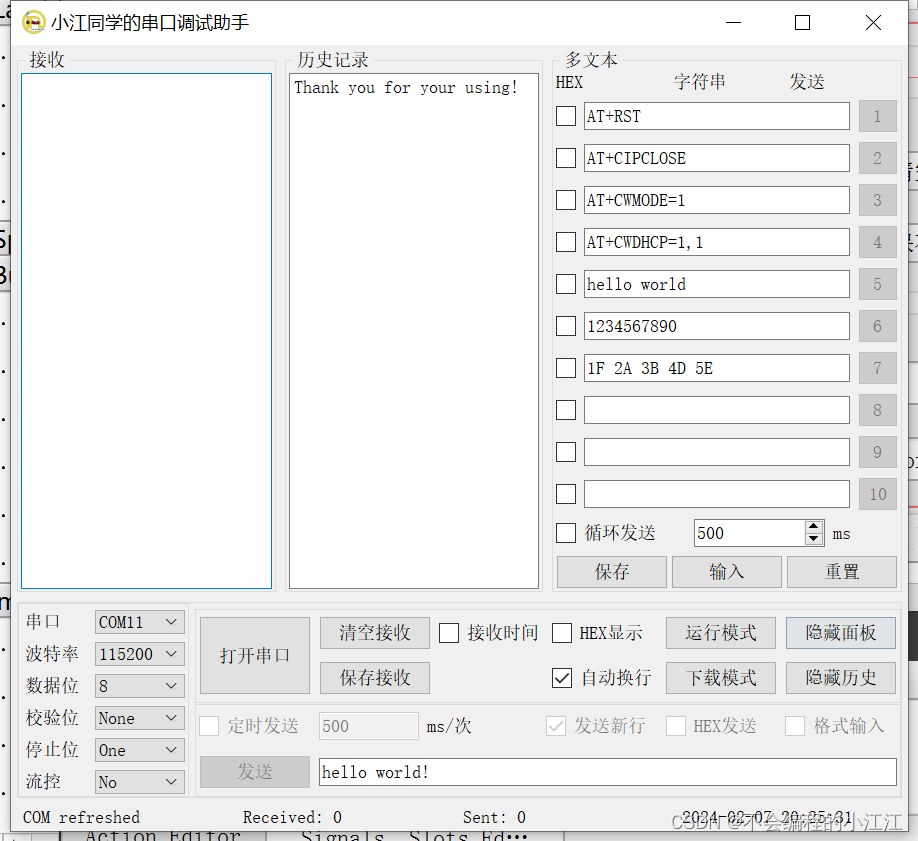
1. Project Overview A serial debug assistant is a tool for serial communication testing. It can open, close, configure serial ports, read and write serial data, and perform other common serial communication operations. It is widely used in embedded system debugging, module testing, communication pro...
Problem Analysis The objective is to cover all occupied stalls in a linear arrangement using a maximum of M boards, minimizing the total length of the boards. If only one board is available, it must span from the leftmost occupied stall to the rightmost. Adding more boards allows leaving gaps betwee...
std::function is a template class introduced in C++11 that serves as a general-purpose wrapper for callable entities. It allows you to store, copy, and invoke a variety of callable objects using a uniform interface. Callable objects in C++ include: Free functions Lambda expressions Function objects...
The Decorator pattern enables adding new responsibilities to an object dynamically without altering its structure. It creates a chain of decorators, each wrapping the previous object, forming a linked structure similar to a linked list. This approach maintains references to original functionality wh...
std::vector implements a dynamically resizable sequence container backed by contiguous memory. This layout enables O(1) random access via indexing, matching raw array performance. Unlike static arrays, vectors manage their own memory footprint, automatically expanding when new elements exceed the cu...
Experiment Objectives Understand the relationship between classes and objects, master constructors and destructors, and implement encapsulation Learn how to define base and derived classes, and understand the calling order of constructors and destructors Master the principles and methods of multiple...
Understanding Polymorphism in C++ What Is Polymorphism? Polymorphism allows the same operation to produce different outcomes depending on the object performing it. Consider the act of purchasing a ticket: a regular customer pays the full price, a student receives a discount, and a soldier gets prior...
When defining a class in C++, the compiler automatically generates six special member functions if the user does not explicitly declare them. These functions handle object lifecycle management—from creation and initialization to copying, assignment, and destruction. Understanding their behavior is c...
In C++, there's a fundamental distinction between working with objects directly and working with pointers to objects. This difference becomes particularly important when implementing data structures like linked lists. Consider the following two initialization patterns: First approach: Node dummy(0);...
The GNU Compiler Collection (GCC) refers to the overarching ecosystem of compilers and related tools designed to handle multiple programming languages, including C, C++, Fortran, and Rust. Within this framework, gcc and g++ serve as specific frontend drivers rather than standalone compilation engine...