Reading INI Configuration Files with Python for API Automation
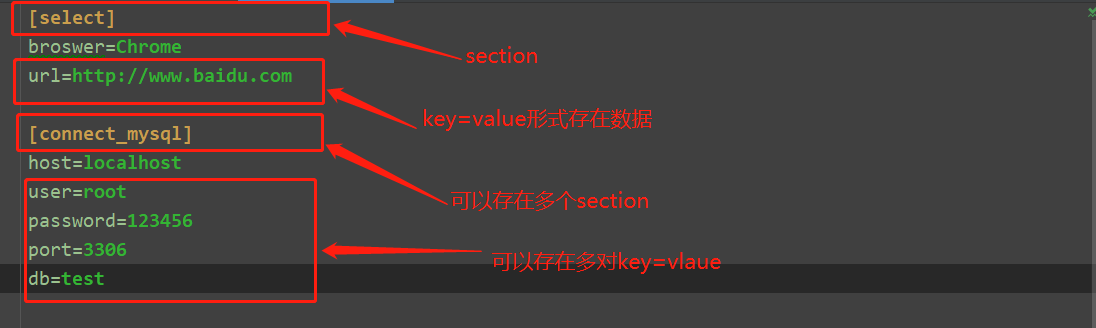
1. Structure of an INI File
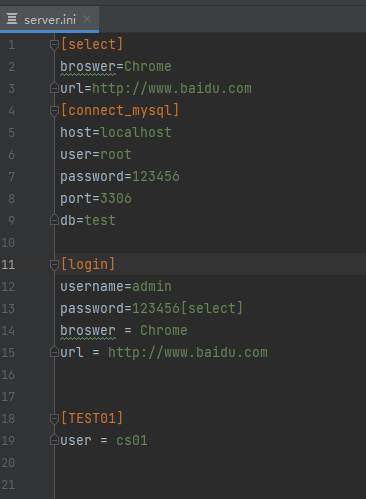
An INI file consists of multpile sections, each storing data in key=value format.
2. Reading INI File Data with Python
2.1 Import the Module
import configparser
config = configparser.ConfigParser()  # Instantiate the class

# Define file path
path = './Config.ini'
2.2 Read File Content
# Method 1: Using read()
config.read(path)
value = config['select']['url']
print('Method 1 value:', value)

# Method 2: Using get()
value = config.get('select', 'url')
print('Method 2 value:', value)

# Method 3: Get all key-value pairs from a section
value = config.items('select')
print('Method 3 value:', value)
Output:

2.3 Reading Typed Data
The methods above return all data as strings. To get specific data types, use:
getint()getfloat()getboolean()
value = config.getint('connect_mysql', 'port')
print('Typed value:', value)
print('Type:', type(value))

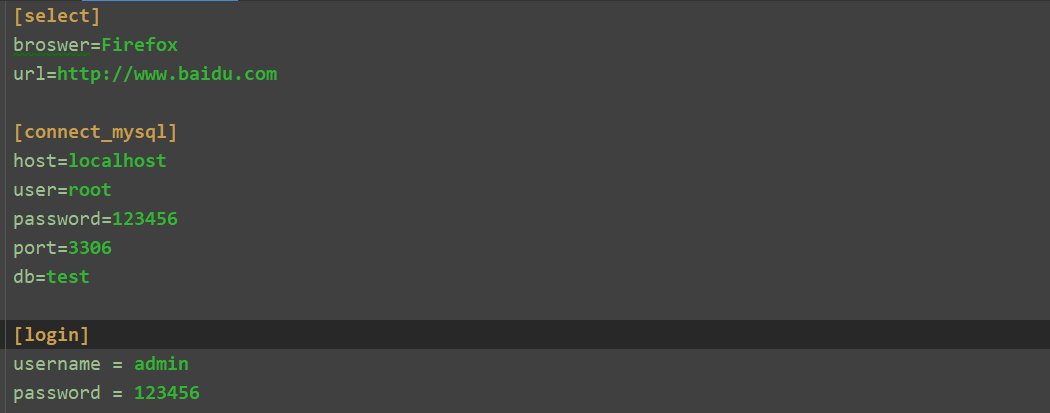
2.4 Writing Data to a INI File
config.add_section('login')  # Add a new section
config.set('login', 'username', 'admin')  # Write key-value
config.set('login', 'password', '123456')
config.write(open(path, 'a'))  # Save to file
2.5 Get All Sections
sections = config.sections()
print(sections)

3. ConfigParser Wrapper Class
For better reusability, we wrap commmon methods into a utility class.
#!/usr/bin/env python
# -*- coding: utf-8 -*-

"""
Utility class for configuration file operations
"""

import configparser


class ConfigUtil:

    def __init__(self):
        self.config = configparser.ConfigParser()

    def read(self, filename):
        """
        Read configuration file
        :param filename: path to the configuration file
        """
        self.config.read(filename, encoding="utf-8-sig")

    def get_value(self, section, option):
        """
        Get value of a specific option from a section
        :param section: section name
        :param option: option key
        :return: value or None if not found
        """
        try:
            return self.config[section][option]
        except Exception:
            print("Value not found")
            return None

    def get_section_items(self, section):
        """
        Get all key-value pairs from a section as list of tuples
        :param section: section name
        :return: list of (key, value) tuples
        """
        return self.config.items(section)

    def get_all_sections(self):
        """
        Get all section names
        :return: list of section names
        """
        return self.config.sections()

    def get_options_in_section(self, section):
        """
        Get all option names in a section
        :param section: section name
        :return: list of option names
        """
        return self.config.options(section)

    def has_section(self, section):
        """
        Check if a section exists
        :param section: section name
        :return: bool
        """
        return section in self.config

    def has_option(self, section, option):
        """
        Check if an option exists in a section
        :param section: section name
        :param option: option key
        :return: bool
        """
        return option in self.config[section]

    def get_typed_value(self, section, option, data_type="int"):
        """
        Get value with specified type
        :param section: section name
        :param option: option key
        :param data_type: "int", "float", or "boolean"
        :return: typed value
        """
        if data_type == "int":
            return self.config.getint(section, option)
        elif data_type == "float":
            return self.config.getfloat(section, option)
        elif data_type == "boolean":
            return self.config.getboolean(section, option)
        else:
            raise ValueError("Unsupported data type")

    def write_option(self, section, key, value, path):
        """
        Write a key-value to the INI file
        :param section: section name
        :param key: option key
        :param value: option value
        :param path: file path
        """
        if section is None:
            return
        self.config.add_section(section)  # Add section if not exists?
        self.config.set(section, key, value)
        with open(path, 'a') as configfile:
            self.config.write(configfile)


if __name__ == '__main__':
    util = ConfigUtil()
    file_path = './server.ini'
    util.read(file_path)
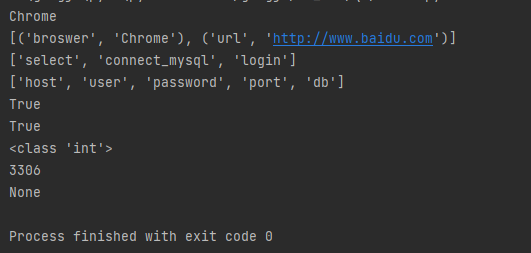
    print(util.get_value('select', 'broswer'))
    print(util.get_section_items('select'))
    print(util.get_all_sections())
    print(util.get_options_in_section('connect_mysql'))
    print(util.has_section('login'))
    print(util.has_option('login', 'username'))
    print(util.get_typed_value('connect_mysql', 'port', 'int'))
    util.write_option('TEST01', 'USER', 'cs01', file_path)
Output: