Advanced C++: Currying and std::bind
1. Currying Process
1.1. Introduction of operator()
Consider a function that returns a different result on each call. For example, two calls should yield different values.
1.1.1. Simple Approach
Using a global (or static) variable that is modified and returned each time.
#include <iostream>

int counter;
int incrementCounter() {
    return ++counter;
}

int main() {
    std::cout << "Hello, World!" << std::endl;
    std::cout << std::boolalpha << (incrementCounter() == incrementCounter()) << std::endl;
    return 0;
}
1.1.2. operator() Overlaoding
Using a class with operator() overloaded (functor).
class Functor {
public:
    int x = 0;
    int operator()() {
        return ++x;
    }
};

void test2() {
    Functor func;
    std::cout << std::boolalpha << (func() == func()) << std::endl;
}
1.2. Chain Adding
Now consider a functon that can be called in a chain: add(1) = 1, add(1)(2) = 3, add(1)(2)(3) = 6, etc. It should also support comparisons like add(1) == 1, and operations like add(1) + 3, add(1) - 3.
- The function
add(1)should return a callable object that can accept further arguments (chainable). - This suggests returning
*thisfromoperator(), enabling chaining. - For comparisons, overload
operator==. - For arithmetic, overload
operator+andoperator-. - For output, overload
<<. - Alternatively, define an implicit conversion to
intto simplify comparisons, arithmetic, and output.
class Functor {
public:
    int value;

    Functor() : value(0) {}
    Functor(int x) : value(x) {}

    Functor& operator()(int val) {
        value += val;
        return *this;
    }

    bool operator==(int x) const {
        return value == x;
    }

    Functor& operator-(int x) {
        value -= x;
        return *this;
    }

    Functor& operator+(int x) {
        value += x;
        return *this;
    }

    friend std::ostream& operator<<(std::ostream& out, const Functor& f) {
        out << f.value;
        return out;
    }

    // Implicit conversion to int (can replace ==, arithmetic, and <<)
    // operator int() const { return value; }
};

int main() {
    Functor f1;
    f1(1);
    std::cout << f1.value << std::endl;

    Functor f2;
    f2(1)(2);
    std::cout << f2.value << std::endl;

    Functor f3;
    std::cout << std::boolalpha << (f3(1) == 1) << std::endl;

    Functor f4(1);
    f4 = f4 - 2;
    f4 = f4 + 5;
    std::cout << f4.value << std::endl;
    std::cout << f4 << std::endl;

    return 0;
}
This demonstrates operator overloading and object-oriented design in C++.
1.3. Currying Process
The chaining above is a form of currying. This is also seen in lambdas that return lambdas:
// Equivalent: add(1, 2) -> add(1)(2)
void test4() {
    auto add = [](int x) {
        return [x](int y) {
            return x + y;
        };
    };
    std::cout << add(1)(2) << std::endl;
}
2. std::bind
std::bind is used for partial function application (binding arguments).
#include <iostream>
#include <functional>

int add(int a, int b) {
    std::cout << "a = " << a << ", b = " << b << std::endl;
    return a + b;
}

int main() {
    using namespace std::placeholders;

    auto f1 = std::bind(add, 1, _1);
    std::cout << f1(2) << std::endl;  // Calls add(1,2)

    auto f2 = std::bind(add, _1, 1);
    std::cout << f2(2) << std::endl;  // Calls add(2,1)

    std::cout << std::bind(add, 1, _1)(2) << std::endl;
    std::cout << std::bind(add, _1, _2)(3, 4) << std::endl;
    std::cout << std::bind(add, _2, _1)(3, 4) << std::endl;
    std::cout << std::bind(add, _1, _1)(3, 4) << std::endl;
    std::cout << std::bind(add, _2, _2)(3, 4) << std::endl;

    // C++20: std::bind_front
    // std::cout << std::bind_front(add, 1)(2) << std::endl;
    // C++23: std::bind_back
    // std::cout << std::bind_back(add, 2)(1) << std::endl;

    return 0;
}
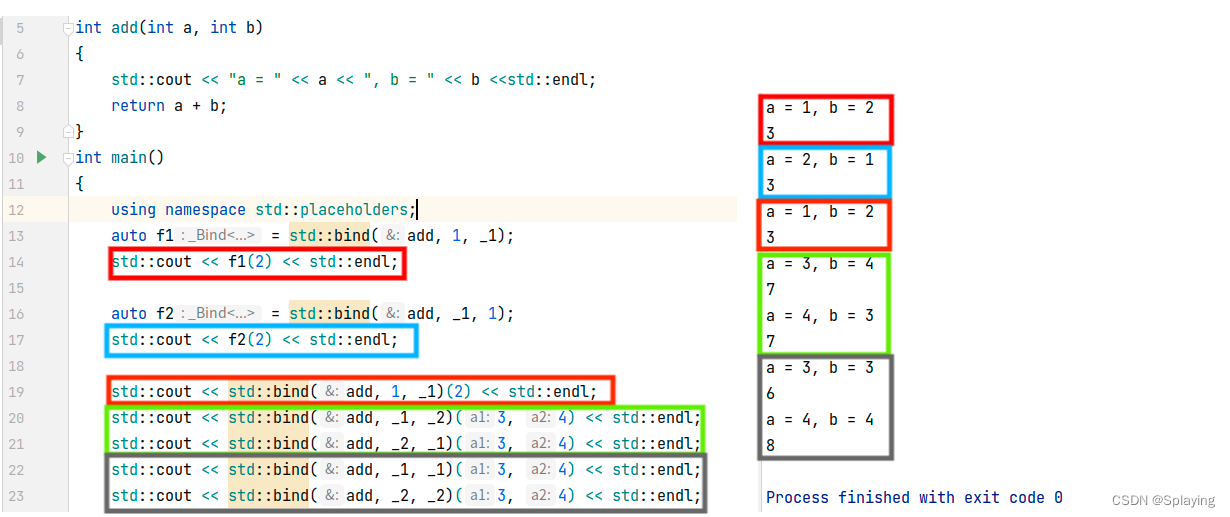
- The placeholder
_irefers to the i-th argument of the resulting callable. - Multiple placeholders can map to the same argument.
std::bindis closely related to perfect forwarding andstd::forward.
