This review focuses on core techniques for arrays and linked lists, including practical C++ implementations. Arrays The most important concept for array problems is the two-pointer technique. Fast and Slow Pointers When removing or manipulating elements, nested loops lead to O(n²) time complexity. U...
Linked List Fundamentals Unlike arrays, which occupy contiguous memory blocks, linked lists connect data scattered across different memory locations using pointers. This structure makes inserting and deleting nodes highly efficient. A typical singly linked list node can be defined as follows: struct...
Linked List Core Concepts A linked list organizes elements using nodes that are connected via references. Each node contains a data field and a link to the next node, with the final node pointing to None. The entry point is called the head. Common Variants Singly Linked List Nodes store a value and...
A linked list is a linear data structure where each element—called a node—contains data and a reference (or pointer) to the next node in the sequence. Unlike arrays, linked lists do not require contiguous memory allocation and can dynamically grow or shrink at runtime. Each node typically consists o...
Given a binary tree: struct Node { int val; Node *left; Node *right; Node *next; } Populate each next pointer to point to its next right node. If there is no next right node, the next pointer should be set to NULL. Initially, all next pointers are set to NULL. Example 1: Input: root = [1,2,3,4,5,nul...
A doubly circular linked list augmented with a sentinel node (dummy head) represents one of the most robust sequential data structures in low-level programming. Unlike singly linked variants, this architecture maintains bidirectional references and circular connectivity, enabling O(1) operations at...
Combining two sorted lists involves iteratively comparing nodes and linking the smaller value to the result list. The process resembles a zipper mehcanism or enzymatic assembly. A dummy head node simplifies edge-case handling. #include <stdlib.h> struct Node { int data; struct Node* link; }; s...
Linear data structures fall into two primary categories: contiguous arrays and linked sequences. A linked sequence organizes elements as self-contained units connected via references. Each unit, called a node, holds two parts: stored data and a reference pointing to the subsequent node, with the fin...
When solving this problem initially, many developers might skip using a dummy head node and handle the swap directly. Here’s how that works: Define two nodes firstNode and secondNode to represent the adjacent pair being swapped, plus a nextPairHead to store the starting point of the next unprocessed...
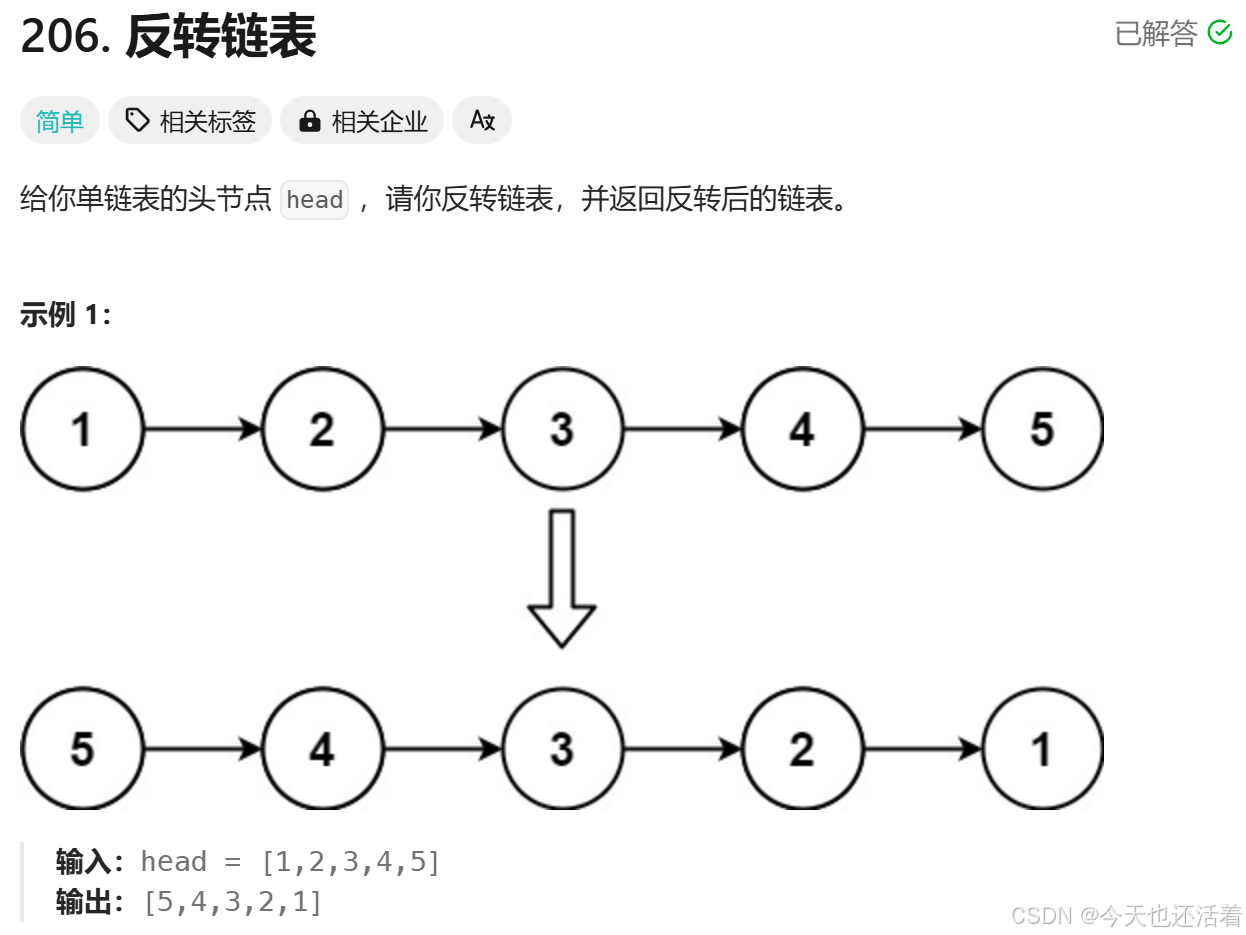
LeetCode Problem 206: Reverse Linked List Problem Description: Solution: Using a two-pointer approach with previous and current pointers, iteratively modify pointer directions. Pay atttention to the loop termination condition; return the previous pointer as the new head node. /** * Definition for si...