Linear data structures fall into two primary categories: contiguous arrays and linked sequences. A linked sequence organizes elements as self-contained units connected via references. Each unit, called a node, holds two parts: stored data and a reference pointing to the subsequent node, with the fin...
Introduction In high-concurrency scenarios, three key mechanisms are essential to ensure service stability: caching, circuit breaking/degradation, and rate limiting. Rate limiting serves as a core self-protection mechanism that prevents system collapse under extreme concurrency, especially when othe...
Core Concepts for String Operations Java Input/Output Basics For reading from standard input: Scanner sc = new Scanner(System.in); For writing to standard output: System.out.println(); String Characteristics in Java Strings are immutable objects in Java. The length of a string can be obtained using...
Sorting Fundamentals Sorting rearranges elements in a list so that they follow a specific order based on their keys. Evaluation Metrics Time Complexity: Number of operations required. Space Complexity: Memory usage during execution. Stability: Maintains relative order of equal elements after sorting...
Roman numerals utilize seven specific symbols: I, V, X, L, C, D, and M. Their corresponding values are: Symbol Value I 1 V 5 X 10 L 50 C 100 D 500 M 1000 Numbers are formed by combining these symbols, typically written from largest to smallest value from left to right. For instance, "XII"...
Circular seating arrangements introduce rotational symmetry, distinguishing them from linear sequences. In a linear arrangement of $n$ items, there are $n!$ possible permutations. How ever, when items are placed around a circle, rotating the entire configuration does not alter the relative order of...
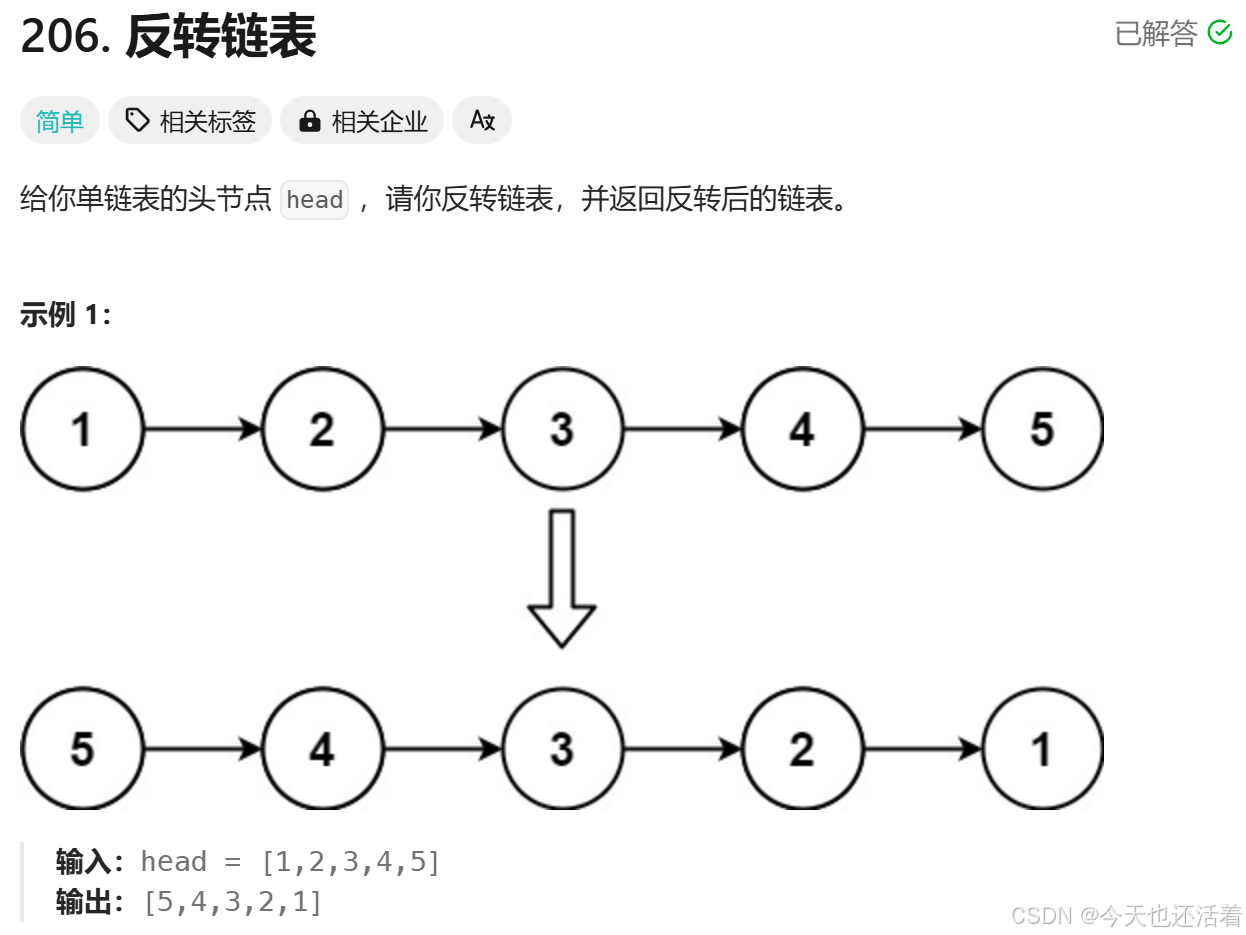
LeetCode Problem 206: Reverse Linked List Problem Description: Solution: Using a two-pointer approach with previous and current pointers, iteratively modify pointer directions. Pay atttention to the loop termination condition; return the previous pointer as the new head node. /** * Definition for si...
A common pattern in two-pointer algorithms involves iterating through a sequence while adjusting a second pointer to maintain a specific condition. for (int left = 0, right = 0; right < n; right++) { while (left < right && condition(left, right)) left++; // Process the current window }...
Reverse Polish Notation (RPN), or postfix notation, is evaluated using a stack data structure. The algorithm iterates through an array of tokens. When a numeric token is encountered, it is pushed onto the stack. Upon encountering an operator (+, -, *, /), the two most recent numbers are popped from...
13.1 Backtracking Algorithm The "backtracking algorithm" is a problem-solving method that relies on exhaustive search. Its core concept is to start from an initial state and use brute force to search for all possible solutions. When a correct solution is found, it is recorded. The process...