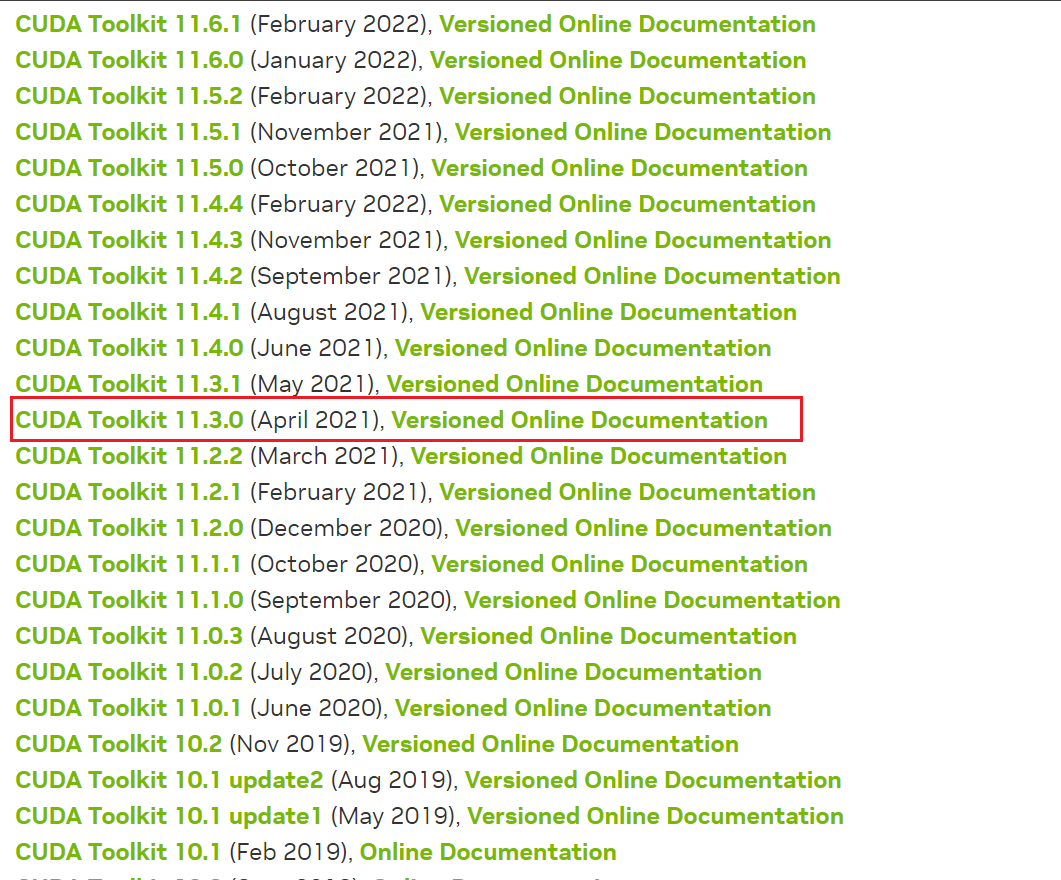
CUDA is the runtime library for GPU‑accelerated deep learning, while cuDNN provides optimized primitives that speed up training. Both are required for a typical machine learning stack: tensorflow‑gpu (or PyTorch) + CUDA + cuDNN. The cuDNN version must be compatible with the installed CUDA toolkit. P...
Prerequisites Install CUDA Toolkit and cuDNN. Download the prebuilt ONNX Runtime binaries that match your CUDA major version—for example, use the CUDA 12.x package when your toolkits 12.1. Extract the archive and register the library folder in your system PATH. For GPU execution, the following dynam...
Modern GPUs from various manufacturers share similar core architectures despite differences in hardware and software implementations. The NVIDIA ecosystem, being closed-source, presents challenges in understanding GPU scheduling strateiges. This analysis covers three key aspects: the CUDA programmin...
Importance of Identifying Your CUDA Version Identifying the exact CUDA toolkit version installed on a system is critical for several reasons. Deep learning frameworks and GPU-accelerated libraries often have strict version requirements, and mismatched environments lead to runtime crashes or compilat...
Exceuting standard TensorFlow operations on a Windows system equipped with an NVIDIA GPU can trigger specific runtime failrues. A common scenario involves the following crash logs: 2019-04-02 09:50:47.986024: I C:\users\nwani\_bazel_nwani\swultrt5\execroot\org_tensorflow\tensorflow\core\common_runti...
PyTorch represents data as tensors—multi-dimensional arrays of a single data type—wrapped in a class that bundles operations and processing methods. This section covers setting up a working PyTorch environment using Anaconda and CUDA. Anaconda Setup Download Anaconda from https://www.anaconda.com/do...
Building a high-performance video processing environment involves integrating CUDA 12.0, cuDNN 8, and the NVIDIA Video Codec SDK with FFmpeg and OpenCV. This configuration enables hardware-accelerated decoding and encoding directly within a containerized environment. Docker Container Configuration T...
When a kernel is invoked from the host, the CUDA runtime instantiates a collection of threads on the device to execute the kernel code in parallel. These threads are arranged in a hierarchical structure that facilitates both scalability and cooperation: the grid, the thread block, and the individual...
Error Details UserWarning: NVIDIA GeForce RTX 4060 Laptop GPU with CUDA capability sm_89 is not compatible with the current PyTorch installation. The current PyTorch install supports CUDA capabilities sm_37 sm_50 sm_60 sm_61 sm_70 sm_75 compute_37. If you want to use the NVIDIA GeForce RTX 4060 Lapt...
PyTorch binaries after 1.3 dropped support for GPUs with compute capability 3.5 and below, and by 1.7 the prebuilt wheels target compute capability 5.2 or higher. If you have an older GPU (for example, a Kepler device like GT 730M with CC 3.5) and still want GPU acceleration, you can compile PyTorch...