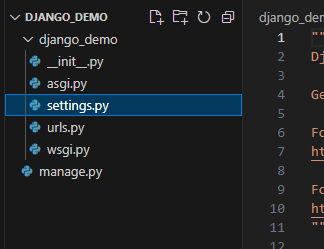
In Django, the URL dispatcher acts as the traffic controller for web requests. When a user accesses a specific URL, the routing system determines which view function handles the request and executes the corresponding logic. This mapping is typically defined in the urls.py file located in the project...
A Django project involves numerous configuration items. Many settings remain at their default values unless specific adjustments are needed. The settings.py file in a Django project is generated during creation and contains project-specific overrides; it does not display all default values. Here is...
When a Django application contains migration files, certain database schema commands become restricted. Attempting to execute sqlall or similar commands results in the following error: CommandError: App 'getssh' has migrations. Only the sqlmigrate and sqlflush commands can be used when an app has mi...
Object-Relational Mapping (ORM) translates programming language constructs into database operations. In Django, every Python class inheriting from models.Model represents a database table, where class attributes map to column definitions. This abstraction eliminates manual SQL execution while preser...
Django operates as a high-level Python web framework that facilitates rapid development with pragmatic architectural patterns. The following procedures outline the complete lifecycle from environment preparation to production readiness. Environment Setup and Installation Initialize a dedicated virtu...
Sending Data with jQuery AJAX The $.ajax method is a versatile tool for making asynchronous HTTP requests. When dealing with complex forms, you can utilize the serialize() method to package all input values into a query string. If your data payload includes arrays, setting traditional: true ensures...
A stable development environment is a prerequisite for building websites with Django. The initial setup, while potentially daunting for newcomers, follows a straightforward sequence akin to initializing CLI projects for other frameworks. Installing Python Django is built on Python. Begin by verifyin...
1. Creating a Project 1.1 Installation Official documentation: https://www.djangoproject.com/download/ pip install Django==5.1.3 1.2 Creating a Project # Navigate to the target directory for your project django-admin startproject project_name 2. Directory Structure Overview First Level: Project Pack...
In Django, an "app" (application) refers to an independent module with specific functionality, typically used to implement different parts or features of a website. By creating apps, you can organize your project code more effectively and make it more reusable. For example, you might creat...
Django views serve as the logic layer of a web application, responsible for processing client requests and returning the appropriate responses. A view is essentially a Python function or class that accepts an HttpRequest object and returns an HttpResponse object, which can contain HTML, JSON data, o...