Chebyshev Synthesis for Antenna Array Beam Pattern Design in MATLAB
Introduction
Antenna arrays are a key technology widely used in wireless communication systems. They form the desired beam pattern by combining multiple radiating elements. The beam pattern describes the radiation intensity distribution of an antenna array in different directions, which is crucial for system performance. The Chebyshev synthesis method is a common technique for designing antenna array beam patterns, capable of producing beam patterns with specific shapes and sidelobe levels.
Chebyshev Polynomials
The Chebyshev synthesis method is based on Chebyshev polynomials, which are a class of orthogonal polynomials with the following form:
T_n(x) = cos(n * arccos(x))
where n is the order of the polynomial, and x is the independent variable ranging between -1 and 1.
Beam Pattern Design
The process of designing an antenna array beam pattern using the Chebyshev synthesis method is as follows:
- Determine the beam pattern shape: First, the required beam pattern shape needs to be determined, such as mainlobe width, sidelobe level, and sidelobe roll-off rate.
- Select Chebyshev order: Based on the desired beam pattern shape, an appropriate Chebyshev order n is chosen.
- Calculate array weights: Using the Chebyshev polynomials and beam pattern shape parameters, the weight for each radiating element in the antenna array is calculated.
- Array synthesis: Based on the calculated weights, the antenna array is synthesized to form the desired beam pattern.
Advantages
The Chebyshev synthesis method offers the following advantages:
- Flexible beam pattern shape: Beam patterns with various shapes can be designed, including narrow mainlobes, low sidelobe levels, and fast sidelobe roll-off.
- Mathematical foundation: This method is based on mathematical principles, providing a solid theoretical basis for accurately predicting beam pattern performance.
- Ease of implementation: The process of calculating array weights and synthesizing the antenna array is relatively straightforward and easy to implement.
Disadvantages
The Chebyshev synthesis method also has some disadvantages:
- Sidelobe level: The sidelobe level may be higher compared to other beam pattern design methods.
- Computational complexity: For high-order Chebyshev polynomials, calculating the array weights can become complex.
- Flexibility: The beam pattern shape is constrained by the Chebyshev order and parameters, wich may not meet all requirements.
Applications
The Chebyshev synthesis method is widely used in various wireless communication systems, including radar, satellite communications, and mobile communications. Its particularly suitable for applications requiring precise beam pattern control and low sidelobe levels.
Conclusion
The Chebyshev synthesis method is an effective technique for designing antenna array beam patterns with specific shapes and sidelobe levels. It offers advantages like flexible beam pattern shapes, a solid mathematical foundation, and ease of implementation. Despite some drawbacks, the Chebyshev synthesis method remains a commonly used approach in antenna array design and plays a significant role in various wireless communication systems.
Example MATLAB Code
Below is an example MATLAB code snippet for Chebyshev synthesis of a linear antenna array:
% Chebyshev Synthesis Method
clear;
clc;

% Parameters
N = 13; % Number of elements, N = 13
if rem(N, 2) == 0 % Summation index M (varies for odd/even)
    M = N / 2;
else
    M = (N - 1) / 2 + 1;
end

RdB = 26; % Mainlobe-to-sidelobe ratio (dB)
lambda = 10; % Wavelength
d = 0.6 * lambda; % Element spacing
theta0 = 60 / 180 * pi; % Scan angle, relative to array axis

% Chebyshev polynomial coefficient matrix A
% T_n(x) = cos(n*arccos(x)) = f(x)
% Each row corresponds to polynomial order n, starting from n=0
% Columns represent powers of x, starting from power 0
A = [1, 0, 0, 0, 0, 0, 0, 0, 0, 0, 0, 0, 0, 0;
     0, 1, 0, 0, 0, 0, 0, 0, 0, 0, 0, 0, 0, 0;
    -1, 0, 2, 0, 0, 0, 0, 0, 0, 0, 0, 0, 0, 0;
     0, -3, 0, 4, 0, 0, 0, 0, 0, 0, 0, 0, 0, 0;
     1, 0, -8, 0, 8, 0, 0, 0, 0, 0, 0, 0, 0, 0;
     0, 5, 0, -20, 0, 16, 0, 0, 0, 0, 0, 0, 0, 0;
    -1, 0, 18, 0, -48, 0, 32, 0, 0, 0, 0, 0, 0, 0;
     0, -7, 0, 56, 0, -112, 0, 64, 0, 0, 0, 0, 0, 0;
     1, 0, -32, 0, 160, 0, -256, 0, 128, 0, 0, 0, 0, 0;
     0, 9, 0, -120, 0, 432, 0, -576, 0, 256, 0, 0, 0, 0;
    -1, 0, 50, 0, -400, 0, 1120, 0, -1280, 0, 512, 0, 0, 0;
     0, -11, 0, 220, 0, -1232, 0, 2816, 0, -2816, 0, 1024, 0, 0;
     1, 0, -72, 0, 840, 0, -3584, 0, 6912, 0, -6144, 0, 2048, 0;
     0, 13, 0, -364, 0, 2912, 0, -9984, 0, 16640, 0, -13312, 0, 4096];
Result Plots
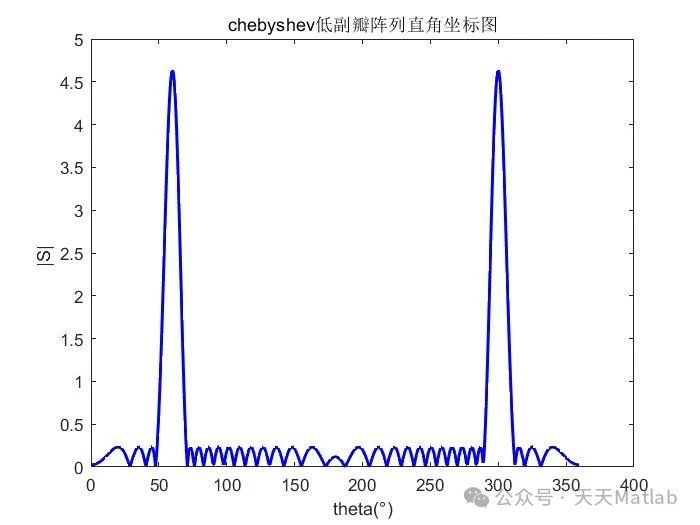
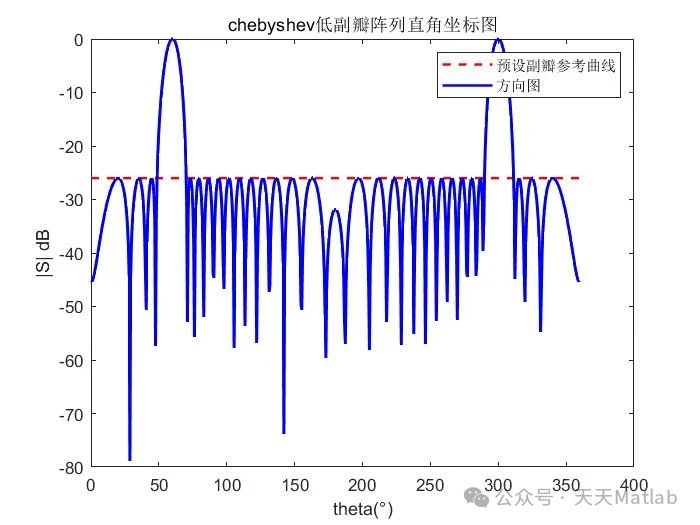
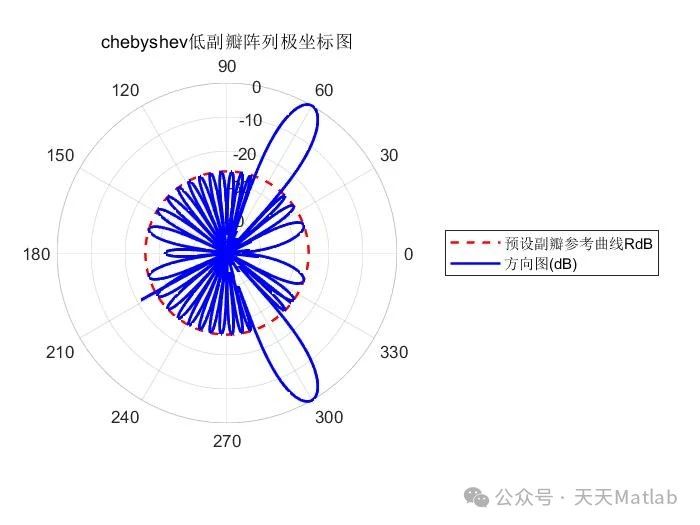
References
[1] Gao, J. (2009). Beamforming of Chebyshev linear array antenna considering mutual coupling. Electronic Test, (4), 1–5.
